Development Status
- 5 - Production/Stable
Environment
- Console
Intended Audience
- Developers
- Other Audience
- Science/Research
Operating System
- Microsoft :: Windows
- POSIX :: Linux
Programming Language
- Python :: 3.10
- Python :: 3.11
- Python :: 3.12
- Python :: 3.13
- Python :: 3.14
Topic
- Scientific/Engineering
- System
- Software Development
Intel(R) Extension for Scikit-learn*


Extension for Scikit-learn is a free software AI accelerator designed to deliver over 10-100X acceleration to your existing scikit-learn code. The software acceleration is achieved with vector instructions, AI hardware-specific memory optimizations, threading, and optimizations.
With Extension for Scikit-learn, you can:
- Speed up training and inference by up to 100x with equivalent mathematical accuracy
- Benefit from performance improvements across different hardware configurations, including GPUs and multi-GPU configurations
- Integrate the extension into your existing Scikit-learn applications without code modifications
- Continue to use the open-source scikit-learn API
- Enable and disable the extension with a couple of lines of code or at the command line
🛠 Installation
Intel(R) Extension for Scikit-learn is available at the Python Package Index, in Conda-Forge and in Intel's conda channel.
To install through pip:
pip install scikit-learn-intelex
See the documentation for more details about supported platforms and other ways of installing it.
You can build the package from sources as well.
⚡️ Get Started
Easiest way to benefit from accelerations from the extension is by patching scikit-learn with it:
- Enable CPU optimizations
import numpy as np
from sklearnex import patch_sklearn
patch_sklearn()

from sklearn.cluster import DBSCAN

X = np.array([[1., 2.], [2., 2.], [2., 3.],
              [8., 7.], [8., 8.], [25., 80.]], dtype=np.float32)
clustering = DBSCAN(eps=3, min_samples=2).fit(X)
-
Enable GPU optimizations
Note: executing on GPU has additional system software requirements - see details.
import numpy as np
from sklearnex import patch_sklearn, config_context
patch_sklearn()

from sklearn.cluster import DBSCAN

X = np.array([[1., 2.], [2., 2.], [2., 3.],
              [8., 7.], [8., 8.], [25., 80.]], dtype=np.float32)
with config_context(target_offload="gpu:0"):
    clustering = DBSCAN(eps=3, min_samples=2).fit(X)
Usage without patching
Alternatively, all functionalities are also available under a separate module which can be imported directly, without involving any patching.
-
To run on CPU:
import numpy as np
from sklearnex.cluster import DBSCAN

X = np.array([[1., 2.], [2., 2.], [2., 3.],
              [8., 7.], [8., 8.], [25., 80.]], dtype=np.float32)
clustering = DBSCAN(eps=3, min_samples=2).fit(X)
-
To run on GPU:
import numpy as np
from sklearnex import config_context
from sklearnex.cluster import DBSCAN

X = np.array([[1., 2.], [2., 2.], [2., 3.],
              [8., 7.], [8., 8.], [25., 80.]], dtype=np.float32)
with config_context(target_offload="gpu:0"):
    clustering = DBSCAN(eps=3, min_samples=2).fit(X)
🚀 Scikit-learn patching
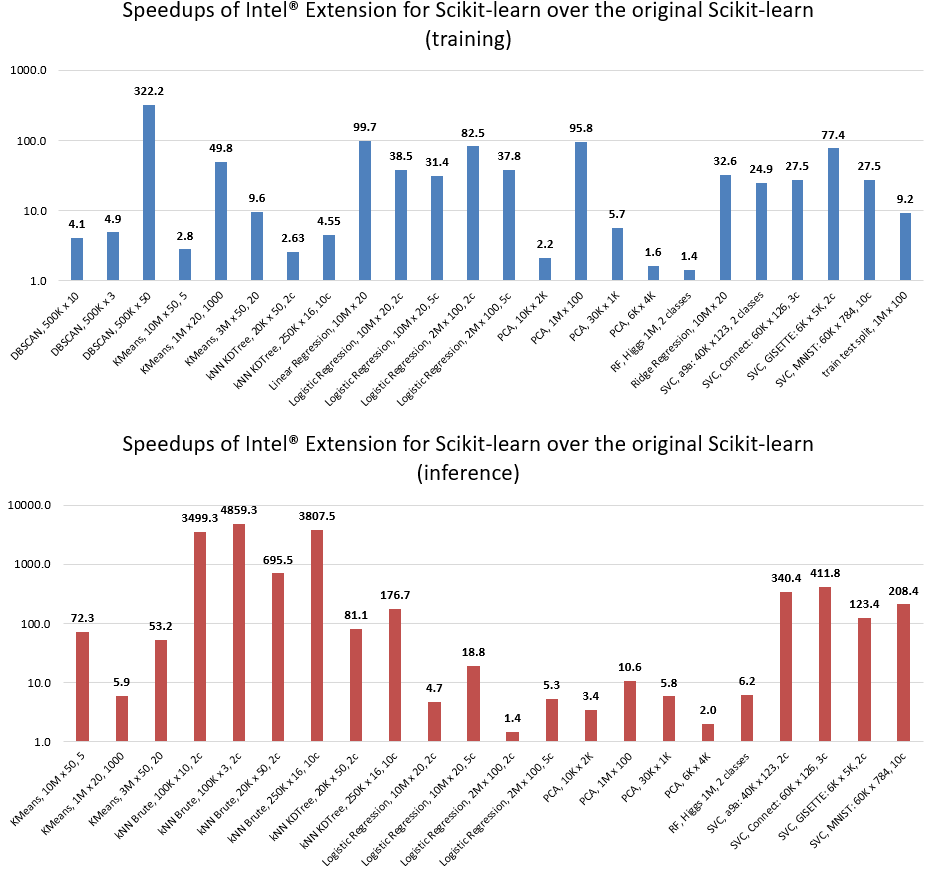 Configurations:
- HW: c5.24xlarge AWS EC2 Instance using an Intel Xeon Platinum 8275CL with 2 sockets and 24 cores per socket
- SW: scikit-learn version 0.24.2, scikit-learn-intelex version 2021.2.3, Python 3.8
Intel(R) Extension for Scikit-learn patching affects performance of specific Scikit-learn functionality. Refer to the list of supported algorithms and parameters for details. In cases when unsupported parameters are used, the package fallbacks into original Scikit-learn. If the patching does not cover your scenarios, submit an issue on GitHub.
Read more about it in the documentation for scikit-learn patching.
👀 Follow us on Medium
We publish blogs on Medium, so follow us to learn tips and tricks for more efficient data analysis with the help of Intel(R) Extension for Scikit-learn. Here are our latest blogs:
- Save Time and Money with Intel Extension for Scikit-learn
- Superior Machine Learning Performance on the Latest Intel Xeon Scalable Processors
- Leverage Intel Optimizations in Scikit-Learn
- Intel Gives Scikit-Learn the Performance Boost Data Scientists Need
- From Hours to Minutes: 600x Faster SVM
- Improve the Performance of XGBoost and LightGBM Inference
- Accelerate Kaggle Challenges Using Intel AI Analytics Toolkit
- Accelerate Your scikit-learn Applications
- Accelerate Linear Models for Machine Learning
- Accelerate K-Means Clustering
🔗 Important links
- Notebook examples
- Documentation
- scikit-learn API and patching
- Benchmark code
- Building from Sources
- About Intel(R) oneAPI Data Analytics Library
💬 Support
Report issues, ask questions, and provide suggestions using:
You may reach out to project maintainers privately at onedal.maintainers@intel.com
Wheel compatibility matrix
| Platform | Python 3.10 | Python 3.11 | Python 3.12 | Python 3.13 | Python 3.14 |
|---|---|---|---|---|---|
| manylinux_2_28_x86_64 | |||||
| win_amd64 |
