Development Status
- 5 - Production/Stable
Environment
- Web Environment
Framework
- Pytest
Intended Audience
- Developers
Natural Language
- English
Operating System
- OS Independent
Programming Language
- Python
- Python :: 3
- Python :: 3 :: Only
- Python :: 3.10
- Python :: 3.11
- Python :: 3.12
- Python :: 3.13
- Python :: 3.14
Topic
- Software Development :: Libraries :: Python Modules
- Software Development :: Testing

pytest-postgresql




What is this?
This is a pytest plugin that enables you to test code relying on a running PostgreSQL database. It provides fixtures for managing both the PostgreSQL process and the client connections.
Quick Start
Install the plugin:
pip install pytest-postgresqlYou will also need to install psycopg (version 3). See its installation instructions.
For async tests with psycopg.AsyncConnection, install the optional async extra:
pip install pytest-postgresql[async]This installs:
pytest-asyncio (>= 1.4) — required for @pytest.mark.asyncio and postgresql_async fixtures.
aiofiles (>= 23.0) — required only when loading SQL files via the async loader (sql_async).
On Windows, the plugin configures a SelectorEventLoop automatically for asyncio tests when no earlier pytest-asyncio loop factory is registered. This is required because psycopg async is incompatible with the default ProactorEventLoop on Windows (documented by psycopg). Without it, postgresql_async tests fail with Psycopg cannot use the 'ProactorEventLoop' to run in async mode. No extra configuration is needed when you install pytest-postgresql[async].
With pytest-asyncio >= 1.4 on Windows, the plugin registers a selector loop factory via pytest-asyncio’s loop-factory hook for all asyncio tests when no prior factory is provided. On Python 3.14+, the legacy asyncio policy fallback is not used because that API is deprecated.
When an earlier hook implementation already supplies loop factories, those are preserved unchanged. Tests that use a prior factory may show different loop names in pytest IDs (for example test_example[custom] instead of test_example[selector]).
If you use an older pytest-asyncio (< 1.4) on Windows with Python < 3.14, the plugin falls back to setting a global WindowsSelectorEventLoopPolicy for the entire test session — not only for postgresql async tests. That can change event-loop behaviour for unrelated asyncio tests in the same run. Install pytest-postgresql[async] (which pulls pytest-asyncio >= 1.4) to avoid that legacy path.
pytest-asyncio configuration
pytest-asyncio 1.x defaults to asyncio_mode = strict, so each async test must be marked with @pytest.mark.asyncio. If you set asyncio_mode = auto in pytest.ini or pyproject.toml, unmarked async test functions are detected automatically — postgresql_async still requires the [async] extra.
[pytest] asyncio_mode = strictRun a test:
Simply include the postgresql fixture in your test. It provides a connected psycopg.Connection object.
def test_example(postgresql):
    """Check main postgresql fixture."""
    with postgresql.cursor() as cur:
        cur.execute("CREATE TABLE test (id serial PRIMARY KEY, num integer, data varchar);")
        postgresql.commit()
For async code, use postgresql_async with pytest.mark.asyncio:
import pytest

@pytest.mark.asyncio
async def test_example_async(postgresql_async):
    """Check main async postgresql fixture."""
    async with postgresql_async.cursor() as cur:
        await cur.execute(
            "CREATE TABLE test (id serial PRIMARY KEY, num integer, data varchar);"
        )
        await postgresql_async.commit()
How to use
How does it work
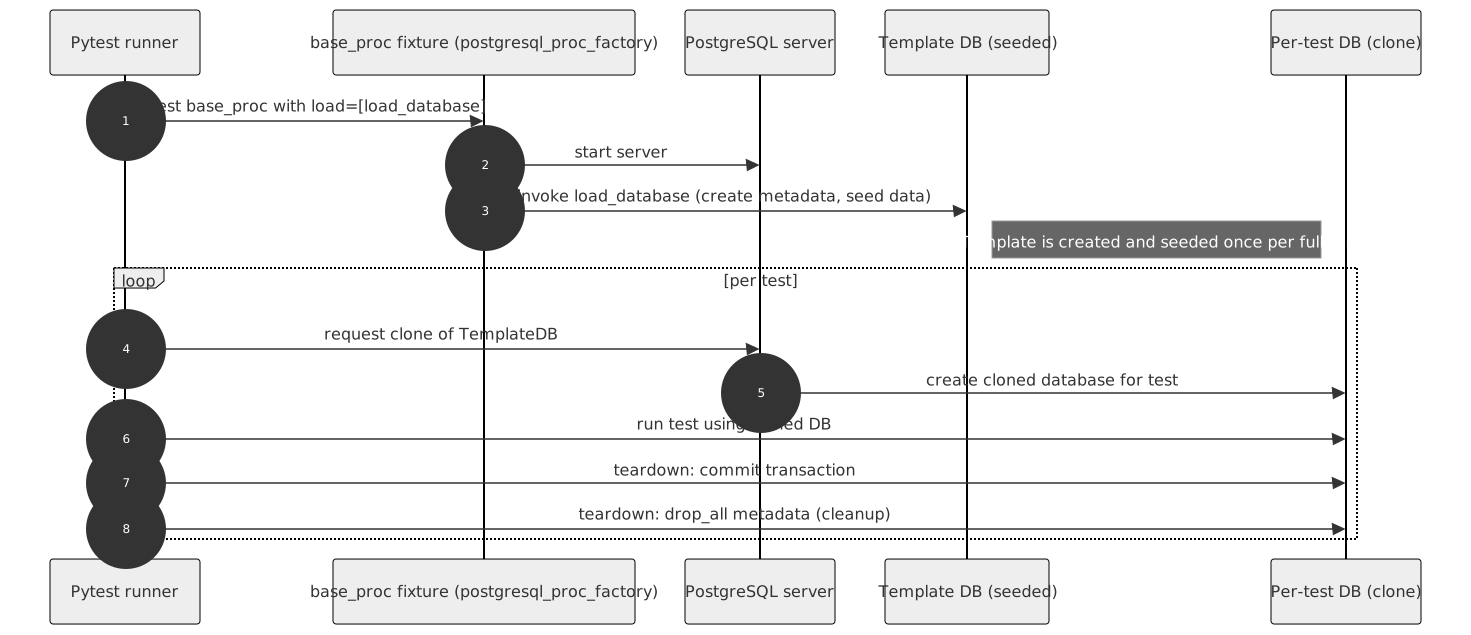
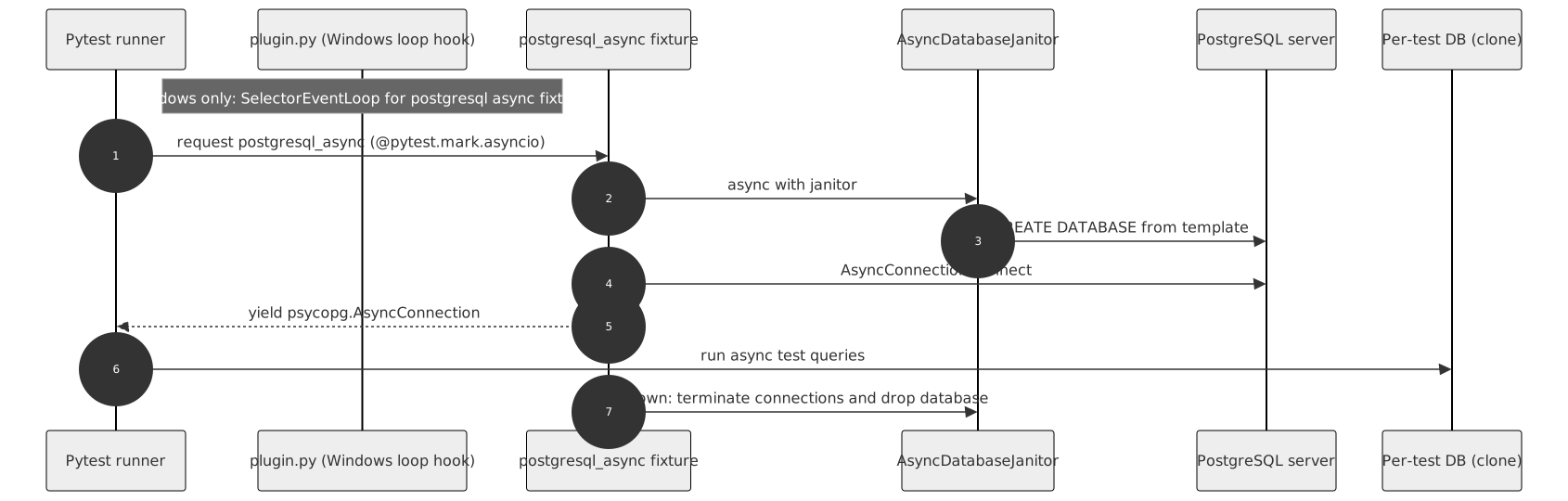
The plugin provides two main types of fixtures:
- 1. Client Fixtures
These provide a connection to a database for your tests.
postgresql - A function-scoped fixture. It returns a connected psycopg.Connection. After each test, it terminates leftover connections and drops the test database to ensure isolation.
postgresql_async - The async counterpart. It returns a connected psycopg.AsyncConnection. Requires pytest-postgresql[async] (pytest-asyncio >= 1.4), and each test must be marked with @pytest.mark.asyncio.
- Async fixtures
postgresql_async and custom factories created with factories.postgresql_async are async generator fixtures using pytest_asyncio.fixture.
Minimum versions when installing manually instead of via [async]:
pytest-asyncio >= 1.4
aiofiles >= 23.0        # only for async SQL file loading
If pytest-asyncio is missing, fixture setup raises ImportError.
Async SQL file loading
Process and noproc fixtures always populate their template database synchronously during session setup (via DatabaseJanitor.load()), even when you use postgresql_async as the client fixture. SQL Path entries in a process fixture load list are executed with the sync sql() loader.
Use sql_async (requires aiofiles from the [async] extra) when you call AsyncDatabaseJanitor.load() directly with a Path. Callable loaders passed to AsyncDatabaseJanitor.load() may be sync or async; return values that are awaitable are awaited automatically.
from pathlib import Path from pytest_postgresql import factories postgresql_my_proc = factories.postgresql_proc(load=[Path("schema.sql")]) postgresql_my_async = factories.postgresql_async("postgresql_my_proc")- 2. Process Fixtures
These manage the PostgreSQL server lifecycle.
postgresql_proc - A session-scoped fixture that starts a PostgreSQL instance on its first use and stops it when all tests are finished.
postgresql_noproc - A fixture for connecting to an already running PostgreSQL instance (e.g., in Docker or CI).
Customizing Fixtures
You can create additional fixtures using factories:
from pytest_postgresql import factories

# Create a custom process fixture
postgresql_my_proc = factories.postgresql_proc(
    port=None, unixsocketdir='/var/run')

# Create a client fixture that uses the custom process
postgresql_my = factories.postgresql('postgresql_my_proc')

# Async client fixture (requires pytest-postgresql[async], pytest-asyncio >= 1.4)
postgresql_my_async = factories.postgresql_async('postgresql_my_proc')Pre-populating the database for tests
If you want the database to be automatically pre-populated with your schema and data, there are two levels you can achieve it:
Per test: In a client fixture, by using an intermediary fixture.
Per session: In a process fixture.
The process fixture accepts a load parameter, which supports:
SQL file paths: Loads and executes the SQL files.
Loading functions: A callable or an import string (e.g., "path.to.module:function"). These functions receive host, port, user, dbname, and password and must perform the connection themselves (or use an ORM).
The process fixture pre-populates the database once per session into a template database. The client fixture then clones this template for each test, which significantly speeds up your tests.
from pathlib import Path
postgresql_my_proc = factories.postgresql_proc(
    load=[
        Path("schemafile.sql"),
        "import.path.to.function",
        load_this_callable
    ]
)
Defining pre-population on the command line:
pytest --postgresql-load=path/to/file.sql --postgresql-load=path.to.functionIf a loaded .sql file contains statements that cannot run inside a transaction block (for example CREATE DATABASE), enable autocommit on the loader connection. This can be set without writing a custom loader, via the factory argument, the command line, or pytest.ini:
postgresql_my_proc = factories.postgresql_proc(load=[Path("with_create_db.sql")], load_autocommit=True)pytest --postgresql-load-autocommitConnecting to an existing PostgreSQL database
To connect to an external server (e.g., running in Docker), use the postgresql_noproc fixture.
For async tests against an external server, create a client fixture with factories.postgresql_async("postgresql_noproc") (see tests/examples/test_drop_test_database_async.py).
postgresql_external = factories.postgresql('postgresql_noproc')By default, it connects to 127.0.0.1:5432.
Using a maintenance database other than postgres
Creating and dropping the test databases requires a connection to a database that already exists - by default postgres. If the test role merely lacks the privilege, GRANT CONNECT ON DATABASE postgres TO myuser is the simpler fix. When postgres is not reachable at all - behind a connection pooler with a fixed database list, or on a managed server that does not expose it - point the noproc fixture at another database:
pytest --postgresql-maintenance-dbname=my_existing_dbpostgresql_external = factories.postgresql_noproc(maintenance_dbname="my_existing_db")The database is only connected to, never created, modified or dropped. Avoid template1: CREATE DATABASE clones it when no template is given, and PostgreSQL does not expect the source database to be in use while it is being copied.
Chaining fixtures
You can chain multiple postgresql_noproc fixtures to layer your data pre-population. Each fixture in the chain will create its own template database based on the previous one.
from pytest_postgresql import factories

# 1. Start with a process or a no-process base
base_proc = factories.postgresql_proc(load=[load_schema])

# 2. Add a layer with some data
seeded_noproc = factories.postgresql_noproc(depends_on="base_proc", load=[load_data])

# 3. Add another layer with more data
more_seeded_noproc = factories.postgresql_noproc(depends_on="seeded_noproc", load=[load_more_data])

# 4. Use the final layer in your test
client = factories.postgresql("more_seeded_noproc")
Configuration
You can define settings via fixture factory arguments, command line options, or pytest.ini. They are resolved in this order:
Fixture factory argument
Command line option
pytest.ini configuration option
Setting |
postgresql_proc argument |
postgresql_noproc argument |
Command line option |
pytest.ini option |
Default |
|---|---|---|---|---|---|
Path to executable |
executable |
n/a |
–postgresql-exec |
postgresql_exec |
discovered (see note) |
host |
host |
host |
–postgresql-host |
postgresql_host |
127.0.0.1 |
port |
port |
port |
–postgresql-port |
postgresql_port |
random (proc), 5432 (noproc) |
Port search count |
— |
n/a |
–postgresql-port-search-count |
postgresql_port_search_count |
5 |
postgresql user |
user |
user |
–postgresql-user |
postgresql_user |
postgres |
password |
password |
password |
–postgresql-password |
postgresql_password |
|
Starting parameters (extra pg_ctl arguments) |
startparams |
n/a |
–postgresql-startparams |
postgresql_startparams |
-w |
Postgres exe extra arguments (passed via pg_ctl’s -o argument) |
postgres_options |
n/a |
–postgresql-postgres-options |
postgresql_postgres_options |
|
Location for unixsockets |
unixsocket |
n/a |
–postgresql-unixsocketdir |
postgresql_unixsocketdir |
$TMPDIR |
Database name |
dbname |
dbname (handles xdist) |
–postgresql-dbname |
postgresql_dbname |
tests |
Maintenance database name |
n/a |
maintenance_dbname |
–postgresql-maintenance-dbname |
postgresql_maintenance_dbname |
postgres |
Default Schema (load list) |
load |
load |
–postgresql-load |
postgresql_load |
|
Autocommit for the SQL loader connection |
load_autocommit |
load_autocommit |
–postgresql-load-autocommit |
postgresql_load_autocommit |
False |
PostgreSQL connection options |
options |
options |
–postgresql-options |
postgresql_options |
|
Drop test database on start |
— |
— |
–postgresql-drop-test-database |
false |
|
Fixture to layer the template database on |
n/a |
depends_on |
— means the setting applies to that fixture but has no factory argument; n/a means the setting does not apply to that fixture at all.
Examples
Using SQLAlchemy
This example shows how to create an SQLAlchemy session fixture:
from typing import Iterator
import pytest
from psycopg import Connection
from sqlalchemy import create_engine
from sqlalchemy.orm import Session, sessionmaker, scoped_session
from sqlalchemy.pool import NullPool

@pytest.fixture
def db_session(postgresql: Connection) -> Iterator[Session]:
    """Session for SQLAlchemy."""
    user = postgresql.info.user
    host = postgresql.info.host
    port = postgresql.info.port
    dbname = postgresql.info.dbname

    connection_str = f'postgresql+psycopg://{user}:@{host}:{port}/{dbname}'
    engine = create_engine(connection_str, echo=False, poolclass=NullPool)

    # Assuming you use a Base model
    from my_app.models import Base
    Base.metadata.create_all(engine)

    SessionLocal = scoped_session(sessionmaker(bind=engine))
    yield SessionLocal()

    SessionLocal.close()
    Base.metadata.drop_all(engine)
Advanced Usage: DatabaseJanitor
DatabaseJanitor is an advanced API for managing database state outside of standard fixtures. It is used by projects like Warehouse (pypi.org).
import psycopg
from pytest_postgresql.janitor import DatabaseJanitor

def test_manual_janitor(postgresql_proc):
    with DatabaseJanitor(
        user=postgresql_proc.user,
        host=postgresql_proc.host,
        port=postgresql_proc.port,
        dbname="my_custom_db",
        password="secret_password",
    ):
        with psycopg.connect(
            dbname="my_custom_db",
            user=postgresql_proc.user,
            host=postgresql_proc.host,
            port=postgresql_proc.port,
            password="secret_password",
        ) as conn:
            # use connection
            pass
Advanced Usage: AsyncDatabaseJanitor
AsyncDatabaseJanitor is the async counterpart to DatabaseJanitor. Use it when managing database state with psycopg.AsyncConnection outside of standard fixtures. It requires psycopg (a core dependency). Install pytest-postgresql[async] when you need aiofiles for SQL file loading via sql_async, or pytest-asyncio for pytest async tests.
import pytest
import psycopg
from pytest_postgresql.janitor import AsyncDatabaseJanitor

@pytest.mark.asyncio
async def test_manual_async_janitor(postgresql_proc):
    async with AsyncDatabaseJanitor(
        user=postgresql_proc.user,
        host=postgresql_proc.host,
        port=postgresql_proc.port,
        dbname="my_custom_db",
        password="secret_password",
    ):
        async with await psycopg.AsyncConnection.connect(
            dbname="my_custom_db",
            user=postgresql_proc.user,
            host=postgresql_proc.host,
            port=postgresql_proc.port,
            password="secret_password",
        ) as conn:
            # use async connection
            pass
Connecting to PostgreSQL in Docker
To connect to a Docker-run PostgreSQL, use the noproc fixture.
docker run --name some-postgres -e POSTGRES_PASSWORD=mysecret -d postgresIn your tests:
from pytest_postgresql import factories

postgresql_in_docker = factories.postgresql_noproc()
postgresql = factories.postgresql("postgresql_in_docker", dbname="test")

def test_docker(postgresql):
    with postgresql.cursor() as cur:
        cur.execute("SELECT 1")
Run with:
pytest --postgresql-host=172.17.0.2 --postgresql-password=mysecretBasic database state for all tests
You can define a load function and pass it to your process fixture factory:
import psycopg
from pytest_postgresql import factories

def load_database(**kwargs):
    with psycopg.connect(**kwargs) as conn:
        with conn.cursor() as cur:
            cur.execute("CREATE TABLE stories (id serial PRIMARY KEY, name varchar);")
            cur.execute("INSERT INTO stories (name) VALUES ('Silmarillion'), ('The Expanse');")

postgresql_proc = factories.postgresql_proc(load=[load_database])
postgresql = factories.postgresql("postgresql_proc")

def test_stories(postgresql):
    with postgresql.cursor() as cur:
        cur.execute("SELECT count(*) FROM stories")
        assert cur.fetchone()[0] == 2
The process fixture populates the template database once, and the client fixture clones it for every test. This is fast, clean, and ensures no dangling transactions. This approach works with both postgresql_proc and postgresql_noproc.
Wheel compatibility matrix
Files in release
 mirakuru
(>=2.6.0)
packaging
port-for
(>=0.7.3)
psycopg
(>=3.0.0)
pytest
(>=8.2)
mirakuru
(>=2.6.0)
packaging
port-for
(>=0.7.3)
psycopg
(>=3.0.0)
pytest
(>=8.2)