Development Status
- 5 - Production/Stable
Environment
- Console
Intended Audience
- Education
- Financial and Insurance Industry
- Healthcare Industry
- Information Technology
- Manufacturing
- Science/Research
License
- OSI Approved :: MIT License
Operating System
- OS Independent
Programming Language
- Python :: 3
Topic
- Office/Business :: Financial
- Office/Business :: Scheduling
- Scientific/Engineering
- Scientific/Engineering :: Artificial Intelligence
- Scientific/Engineering :: Information Analysis
- Scientific/Engineering :: Mathematics
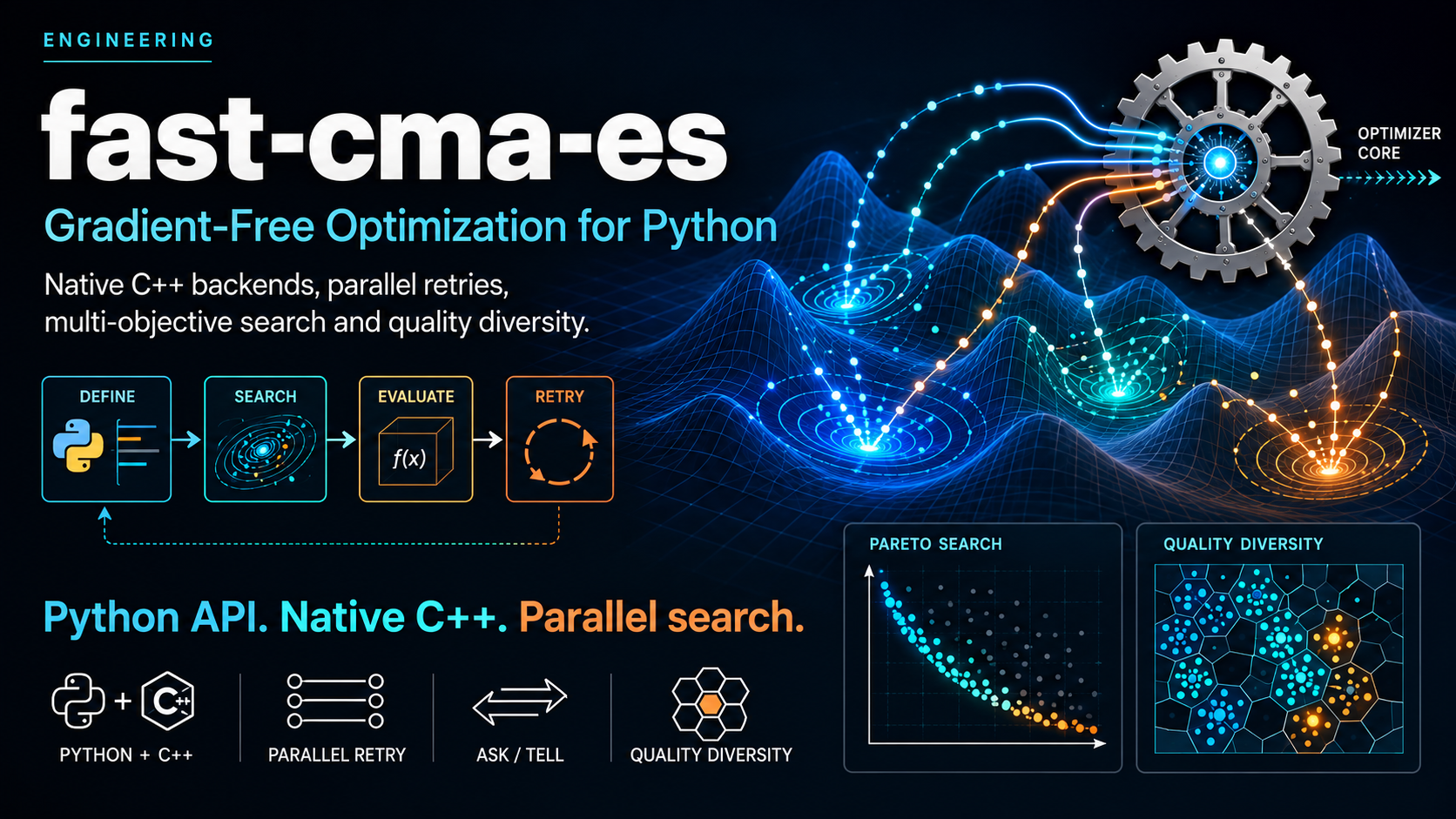
fcmaes
One of 18 related repositories. The repository overview shows what each one does and how they connect.
A Python 3 gradient-free optimization library.
Choosing an optimization tool? Start with the
shared solver-selection and agent guide or the
optimization ecosystem overview.
Use fcmaes for Python black-box objectives, parallel retry, Pareto search
and quality diversity. Durable MCP jobs use the separate Rust workers;
this Python package does not include an MCP server.
- Documentation book
- Full README
- Tutorials
- Python API
- C++ API
- Examples API
- Native Rust implementation (with PyO3 API for Python users)
- The algorithm portfolio of fcmaes-rust: which gradient-free algorithms were selected, which were benchmarked and left out, and the measurements behind each decision
- Optimization jobs: durable jobs and an MCP server for AI agents, with fcmaes-rust workers
- experiment-craft: reproducible campaigns of those jobs (parameter sweeps, dependent steps, budgets and reports); it drives the Rust workers, not this package, and is in early development
- AI agent context: how an AI agent chooses, configures and validates fcmaes optimizers (AGENTS.md for coding agents)
Prompt-driven optimization tutorials demonstrate the shared agent workflow with native Rust application workers. Python objectives continue to use this package in process; these tutorials do not add a worker to fast-cma-es.
The eight CRN/CFD simulator lessons connect stochastic calibration, sensitivities, oscillator searches, source-allocation LP, sensor MIP and coupled-flow validation to complete campaigns. Their runnable examples use native Rust bindings and existing command/scalar-worker routes; they do not add a worker to this package.
Installation
python -m pip install fcmaes
To build from source you need a C++17 compiler and Python 3.10 or newer;
pip fetches the build tools, and Eigen is fetched if it is not installed:
git clone https://github.com/dietmarwo/fast-cma-es
cd fast-cma-es
python -m pip install . --config-settings=cmake.define.FCMAES_FETCH_EIGEN=ON
See the full README for the requirements, the changelog for what changed, and RELEASING.md for the release process.
jSO and jSO→CMA-ES
Use fcmaes.jso for the Python implementation or fcmaes.jsocpp for the
C++ backend. Both support bounded continuous optimization with a hard jSO
evaluation cap, variable-length ask/tell batches, and parallel objective
evaluation through Python processes. fcmaes.optimizer.jso_cma uses jSO
to start CMA-ES. See jSO usage and parameters.
Exact 2D Pareto archive
fcmaes.pareto.ParetoArchive2D keeps all nondominated evaluations of a
two-objective problem and updates their hypervolume with every insertion.
Its native code is derived from bitehv2.h in Aleksey Vaneev's
BiteOpt repository. See
usage and a MODE example.
Third-party integration
OptunaHub's FastCmaesSampler, by Jacob Pfeil, connects fcmaes CMA-ES to Optuna. See its example and supported Optuna version there. This is an external integration, not a comparative benchmark of the five-project ecosystem.
Wheel compatibility matrix
| Platform | CPython 3.10 | CPython 3.11 | CPython 3.12 | CPython 3.13 |
|---|---|---|---|---|
| macosx_10_13_x86_64 | ||||
| macosx_11_0_arm64 | ||||
| manylinux_2_27_x86_64 | ||||
| manylinux_2_28_x86_64 | ||||
| win_amd64 |
