Programming Language
- Python :: 3
- Python :: 3.10
- Python :: 3.11
- Python :: 3.12
- Python :: 3.13
Operating System
- OS Independent
Intended Audience
- Developers
- Science/Research
Topic
- Scientific/Engineering :: Artificial Intelligence
- Text Processing :: Linguistic
chopper-rag
The chopper as a drop-in context compressor and reranker for LangChain, LlamaIndex and Haystack, and as an MCP server for Claude.
The chopper is a fine-tuned mmBERT encoder. It reads the question and the snippets your retriever returned, and cuts out
chops: exact quotes cut out of retrieved snippets, never rewritten. A chop is typically 3-5% of the retrieved
text. Every chop records where it came from (passage[start:end] == text), and the chops work with any answering model.
It also gives one ANSWER / SEARCH decision: whether the snippets seem to contain the answer, or you should search again.
It is also a reranker. The same single pass scores every passage (mean p(KEEP) of its 16 most likely tokens). On a held-out set in 8 languages (400 queries, 16 passages each) it ranks almost as well as dedicated rerankers, at the speed of bge-reranker-v2-m3, with the chops and the decision included:
| nDCG@10 | Hit@1 | GPU time for 16 passages | |
|---|---|---|---|
| chopper (mmBERT-base, one pass) | 0.973 | 0.972 | 0.20 s, chops included |
| bge-reranker-v2-m3 | 0.984 | 0.985 | 0.20 s |
| Qwen3-Reranker-0.6B | 0.977 | 0.972 | 0.77 s |
| Qwen3-Reranker-4B | 0.986 | 0.990 | 3.3 s |
Long documents (since 0.1.10) are ranked by their best window: a passage longer than 900 characters is cut into
900-character windows (stride 450), every window is scored, and each passage's best window is then compared with the
other candidates in one read. Chops are unaffected. This is the setting of the MTEB submission (AlloprofReranking NDCG@10
0.571 → 0.737); Chopper.from_pretrained(window_chars=None) scores whole passages as before.
Long candidate lists (since 0.1.11) are ranked in rounds by chopper.rerank: a relevance is relative to the passages
read in the same pass, so more than 50 candidates are read in blocks of 50, the best 25 of each block are read together,
and the best 10 of those once more. Lists of up to 50 get one plain read, as before. HotpotQA-HN (top 100 of a
first-stage retriever): NDCG@10 0.835 in one ranking vs 0.876 in rounds. rerank(..., tournament=None) turns it off.
So in most pipelines you can drop the reranker: retrieve, then rank and chop in one call. Details and caveats: DETAILS.md.
- Model: huggingface.co/wiiiktor/chopper_mmbert:
base(0.31B, recommended) andsmall(0.14B); for Polish documentsbase-pl(since 0.1.9: the 0.15B chopper on OPI PIB's pl-ModernBERT-base, Apache 2.0; two-hop 56% vs 43% with the previous Polish model),mmbert-base-pl(the previous Polish default, 0.31B: better for mixed-language text and slightly better at ranking Polish passages) andsmall-pl - Code and demo: github.com/wiiiktor/chopper_demo
Install
pip install chopper-rag                  # core only (torch, transformers)
pip install "chopper-rag[langchain]"     # or [llama-index], [haystack], [mcp], [all]
Core
from chopper_rag import Chopper

chopper = Chopper.from_pretrained(variant="base")          # device="auto", threshold from the model config
result = chopper.run("When was the Eiffel Tower completed?", passages)
for c in result.chops:                                      # Chop(passage_index, start, end, text, score)
    assert passages[c.passage_index][c.start:c.end] == c.text
print(result.decision)                                      # "ANSWER" or "SEARCH"
print(result.ranking(top_k=5))                              # [(passage_index, relevance), ...] most relevant first
chops = chopper.chop(question, passages)                    # just the list of Chop
ranked = chopper.rerank(question, passages, top_k=5)        # the chopper as a reranker
In every framework below, mode="rerank" turns the component into a reranker: it returns the input documents / nodes,
most relevant first (top_n, or top_k in Haystack), with the chopper's relevance as their score
(metadata["relevance_score"] in LangChain). The default mode="chop" returns the chops.
LangChain
Listed in the LangChain integrations as ChopperCompressor.
from langchain_classic.retrievers import ContextualCompressionRetriever  # langchain<1.0: langchain.retrievers
from chopper_rag.langchain import ChopperCompressor

compressor = ChopperCompressor.from_pretrained(variant="base")
retriever = ContextualCompressionRetriever(base_compressor=compressor, base_retriever=vectorstore.as_retriever(search_kwargs={"k": 16}))
docs = retriever.invoke("When was the Eiffel Tower completed?")
for d in docs:   # one Document per chop
    print(d.page_content, d.metadata["source_index"], d.metadata["chop_start"], d.metadata["chop_end"])
# or directly: compressor.compress_documents(documents, query)
LlamaIndex
from chopper_rag.llama_index import ChopperPostprocessor

chopper = ChopperPostprocessor(variant="base")
query_engine = index.as_query_engine(similarity_top_k=16, node_postprocessors=[chopper])
response = query_engine.query("When was the Eiffel Tower completed?")
for n in response.source_nodes:   # one TextNode per chop, SOURCE relationship -> the retrieved node
    print(n.node.text, n.node.metadata["chop_start"], n.node.metadata["chop_end"])
# or directly: chopper.postprocess_nodes(nodes, query_str="...")
Haystack (2.x and later)
from haystack import Pipeline
from chopper_rag.haystack import ChopperDocumentCompressor

pipe = Pipeline()
pipe.add_component("retriever", retriever)                          # any retriever, top_k=16
pipe.add_component("chopper", ChopperDocumentCompressor(variant="base"))
pipe.connect("retriever.documents", "chopper.documents")
out = pipe.run({"retriever": {"query": q}, "chopper": {"query": q}})
print([d.content for d in out["chopper"]["documents"]], out["chopper"]["decision"])
MCP server (Claude Desktop, Claude Code, any MCP client)
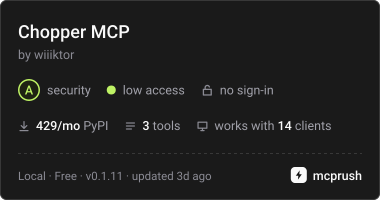
pip install chopper-rag installs chopper-mcp, a stdio MCP server with three tools (no install needed with uv:
uvx chopper-rag runs the same server). It is listed in the official MCP Registry as io.github.wiiiktor/chopper.
| tool | what it does |
|---|---|
chop_passages(question, passages) |
cut the exact quotes that answer question out of a list of texts (search results, tool outputs) |
chop_files(question, paths) |
read local text files, split them into ~1,000-character passages, cut out the quotes; each quote has its file path and character offset |
rank_passages(question, passages, top_k) |
the chopper as a reranker: the top_k passages, most relevant first, with their relevance |
The chop tools return decision (ANSWER / SEARCH), the chops, a ready-to-read context string and the passage
ranking, so the model reads a few quotes instead of whole documents and needs no separate reranker. Claude Code:
claude mcp add chopper -- chopper-mcp # or, without installing: claude mcp add chopper -- uvx chopper-rag
Claude Desktop (claude_desktop_config.json):
{"mcpServers": {"chopper": {"command": "chopper-mcp", "env": {"CHOPPER_VARIANT": "base", "CHOPPER_DEVICE": "auto"}}}}
Settings: CHOPPER_VARIANT (base, small, base-pl, mmbert-base-pl, small-pl), CHOPPER_DEVICE (auto, cpu, cuda), CHOPPER_SNAP (word, sentence, none), CHOPPER_REPO,
CHOPPER_ALLOWED_DIRS (directories chop_files may read, default: your home directory). A GPU is recommended; on a CPU
it works but is slow (about 10 s for 16 passages of 1,000 characters with small, 20 s with base). The model is
downloaded on the first call.
Whole sentences by default (snap)
The model decides per token, so a raw chop can start or end inside a word or a clause. Since 0.1.7 every chop is
extended to the whole sentences it touches, so chops read as complete sentences (97% end at a sentence end, vs 36%
raw) at the cost of a little more text (4.1% of the input kept instead of 3.4% on our held-out set). snap="word" only
avoids cutting inside a word; snap="none" gives the raw token runs. All F1 / accuracy numbers we publish were
measured on raw chops (snap="none"); on that held-out set word snapping leaves F1 unchanged (0.458) and sentence
snapping gives 0.433, because whole sentences also include words outside the gold answer span.
ch = Chopper.from_pretrained(snap="word") # or "none"; or later: ch.snap = "none"
In LangChain / LlamaIndex / Haystack pass such a Chopper as chopper=; in the MCP server set CHOPPER_SNAP.
Output metadata (all three frameworks)
One output document / node per chop, in passage order. Metadata = the source's metadata plus:
| key | meaning |
|---|---|
chop_start, chop_end |
character offsets of the chop in the source text |
source_index |
position of the source in the input list |
chop_score |
mean p(KEEP) over the chop's tokens |
source_relevance |
(LangChain) the chopper's relevance score of the source passage |
source_id |
(Haystack only) id of the source Document |
The score of each output is the score of its source. The last ANSWER / SEARCH decision is in last_decision
(LangChain, LlamaIndex) or in the decision output (Haystack). A source with no chops produces no output; if nothing
is kept, the result is empty (usually together with SEARCH).
Details
- Input:
Question: <q> [SEP] <passage 1> [SEP] ... [SEP] <passage N>, up to 8,192 tokens. Decoding: keep tokens with p(KEEP) > 0.5, merge runs at most 5 tokens apart, drop runs shorter than 4 tokens (fromchopper_config.json;threshold=overrides the cut-off: lower keeps more). - Inputs longer than 8,192 tokens are processed in several passes: passages are packed in order into groups that fit next to the question, and a single passage longer than the budget is cut into token windows. Offsets always refer to the original passage. The model was trained on ~20 passages of ~1,000 characters, which fit one pass.
- Leading/trailing whitespace of a passage is ignored; offsets still refer to the unstripped text.
- Device:
"auto"= CUDA if available (bfloat16), else CPU (float32). Passrepo=a local directory holdingmmbert-base//mmbert-small/to run offline.
Tests
pip install -e ".[all,test]"
CUDA_VISIBLE_DEVICES="" pytest tests/          # uses mmbert-small; CHOPPER_VARIANT=base for the base model
License: MIT, commercial use allowed (code and the mmBERT weights). Naver's Provence / XProvence pruners, the closest alternatives, are CC BY-NC-ND 4.0 (non-commercial).
Wheel compatibility matrix
Files in release
 torch
(>=2.1)
transformers
(>=4.48)
safetensors
huggingface_hub
numpy
mcp
(>=1.2)